I'm launching a project
I'll assemble a distributed team, organize transparent contribution tracking, and own the project.
- Create a project and recruit a team
- Milestones, tasks, and acceptance
- Team contribution tracking
Bring on a couple of helpers with no budget, break work into tasks, and track who did what. You'll add a share of future revenue when the product starts earning.
Are you a founder or a contributor?
Choose where to start. You can add another role later in your profile.
I'm launching a project
I'll assemble a distributed team, organize transparent contribution tracking, and own the project.
I'm a contributor
I'll find a project and earn verified contribution for results — code, design, marketing, or sales.
Calculate equity shares free, no signup
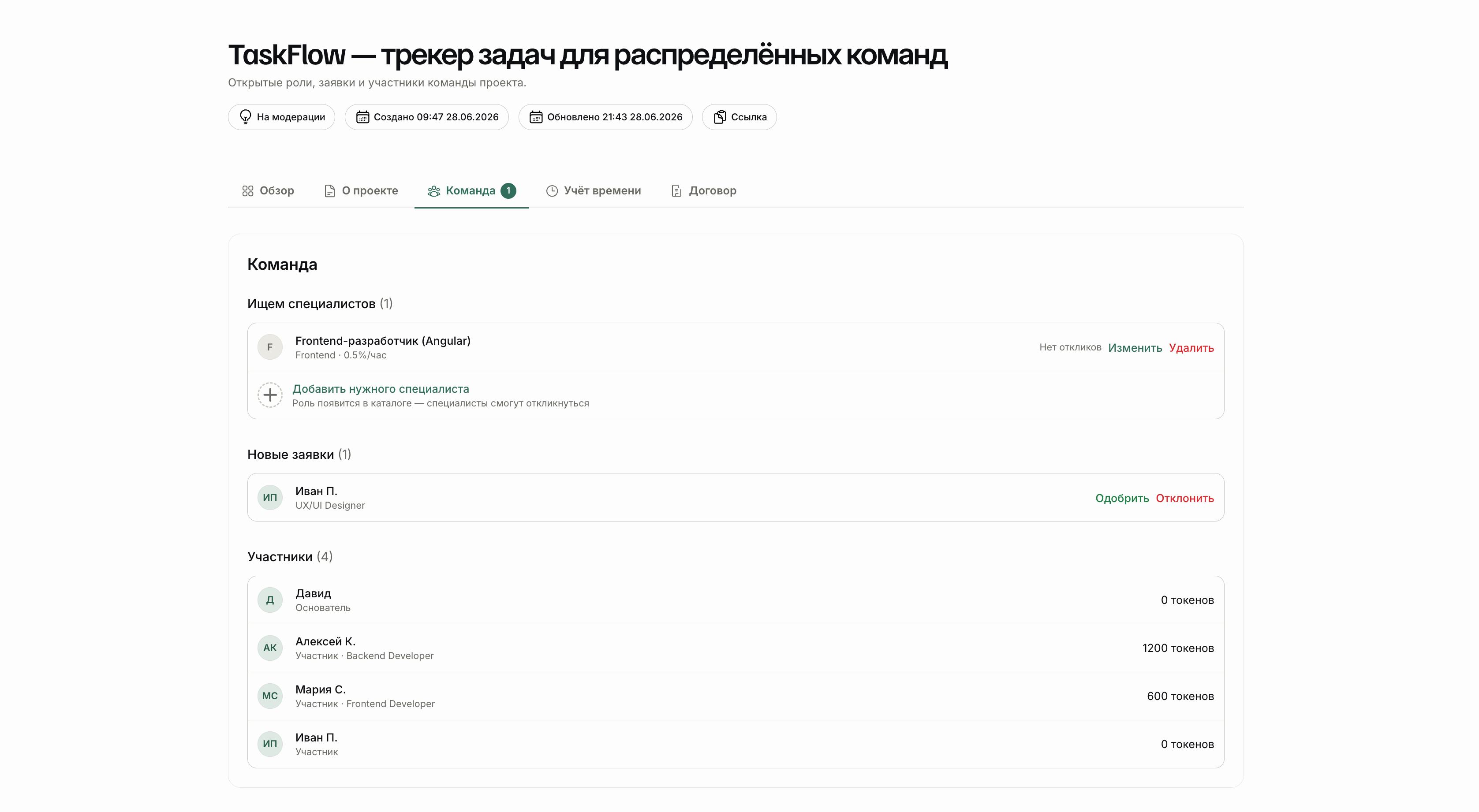
This is what the project interface looks like
For teams building products through contribution
Code, design, marketing, and sales in one project history
Tasks, artifacts, and confirmations instead of DMs
Founders and contributors in one ecosystem
Even a small product needs many hands: code, design, landing page, copy, first sales. There's no budget for a team, and agreements live in DMs.
One person rarely has every skill and enough time for a product.
The product takes off — and everyone remembers what was agreed differently.
If the project was shelved or didn't take off, there's nothing to show for your work.
Describes the idea, stage, roles, tasks, and participation rules.
Choose tasks and record work results.
Each contribution is reviewed and added to the contribution log.
The contributor gets a provable history of work on the project.
When a project is ready, the parties formalize a contractual model for sharing future value. How it works
Reviews existing projects, their goals, stage, tasks, participation terms, and need for specialists.
Applies for a fitting role, agrees on the format of participation, and picks tasks where they can add value.
Work results are saved in the project and form a transparent participation history.
The team reviews the completed work, then it is added to the contribution log.
The contributor gets a verified history of work on real products that can be used in future projects.
If the project provides equity, an option, or another reward for contribution, the parties lock terms into a contractual model. How it works
Roles, tasks, results and confirmations in one transparent project history. You can see who did what.
The founder describes the idea, team, roles, and participation rules.
Contributors attach results: code, mockups, copy, leads, research, and other materials.
The system collects contribution history: who did what, when, and to what extent.
The founder or team confirms contribution so it becomes part of reputation and project rules.
When a project is ready to formalize terms, a contractual model for sharing future value kicks in. How it works
You don't have to be a "startup founder". An idea and the drive to build something of your own is enough.
A small subscription service that solves one job. Not a unicorn — steady side income.
You build products on your own, in short iterations, evenings and weekends — but you already need help.
A designer, developer, marketer, or seller who wants to build something of their own — but without a team or budget.
You don't have to launch your own startup. You can join someone else's idea, contribute your skills, and become a co-founder of the project.
A developer, designer, marketer, analyst, or seller who wants more than routine hired work and wants to shape the product outcome.
You know how to build products, but haven't found an idea you want to grow on your own yet. Pick a ready project and join its team.
You want to use free evenings or weekends to gain experience, build a strong portfolio, and earn money or equity in a promising project.
For founders
Publish a project, describe roles, break work into tasks, and track each contributor's contribution.
For contributors
Choose projects, complete tasks, attach results, and build a provable history of your participation.
What makes it different
Inside a project you can pay for work like on freelance, or accept contribution for equity like nowhere else. Contribution is recorded either way.
payment for specific work
↳ also available inside the project
one-off deal — no lasting trace
you enter with work, contribution is visible
no payment
no equity
pay for work or take contribution for equity
contribution is recorded either way
equity in the future — optional
Pay like a freelancer or split equity — whatever suits the project. The difference is that contribution stays on record and can become equity.
The question everyone asks: how is this different from what I already know?
DevStake records different types of results: from pull requests to the first customer. The key is that contribution must be specific, verifiable, and tied to project progress.
The short version of what matters about money and rights.
Apply to the private Telegram channel — or leave your phone, and we'll reach out personally.
Join the private group or leave your phone. We'll reach out personally.
Open the app or leave your phone. We'll reach out personally.